Dear Family: No Easy Answers
(… on remembering (re-membering) that we belong to each other.)
Dear Family,
Last weekend, I participated in a forum put on by the local Indivisible group framed by the premise that our democracy depends on healing the divides between political adversaries, and on keeping lines of communication open even in the face of fundamental disagreements. The goals of the forum, and specifically my role in it, morphed quite a bit from beginning to end of the planning process, and I am honestly not sure how well we stuck the landing, so to speak. Regardless, the questions it raised for me have been very fruitful to sit with.
Here’s where this has all settled with me:
First off, it’s undeniable that we live in a world that is fractured. Social media algorithms curate deeply divergent worldviews, so that people on opposite sides of pretty much any issue are being fed opposing information. Sometimes I’m shocked that people come to such radically different perspectives from the same information; then I remember that we are not actually working with the same facts, depending on who we’re listening to.
And it’s not just that we don’t all share in the same information. There’s also the reality that the quasi-anonymity of the life on the web creates a sense of distance from our fellow humans. Sometimes that distance leads social media users to be outright nasty to those whose views we find abhorrent. Many of us behave online in ways that we would never dream of behaving in real-life interactions.
I’m not suggesting that we should simply shrug and move on when something comes up that offends our sense of what is right, moral, dignified, and humane. Some of the disagreements we face go to the very essence of who we are as human beings, so they can’t easily be swept under the rug; nor should they be.
In the midst of it all, though, we still have to live in community. We still have to share the same infrastructure. In the face of deep divides, how are we to be neighbors to one another? How are we to enter into conflict in ways that will lead to a common good, and how are we to join forces across differences to face external evils without tearing each other to pieces? How can we remember that we belong to each other and are responsible for each other, whether we agree on the fundamentals of morality or not? Last week’s forum helped me to name these issues in my own heart. If we’d had more time or perhaps if we’d used our time differently, we might have dipped into the deeper work that will, I suspect, be necessary if we are to move forward towards communal connection and wholeness. Anyway, those questions feel very alive to me.
I don’t claim to have definitive answers. God knows I find it all too easy to be drawn into online debates that dehumanize either me or others. My deeply human reactivity sometimes overcomes my attempts to remember that not every stimulus requires or deserves a response. That said, when I’m at my best, I do have two strategies that seem to tip the balance towards a less reactive stance in the world.
Although it may seem counter-intuitive, for me the primary strategy for maintaining at least the possibility of relationship across differences is that I must know myself. When faced with an intense difference of opinion, while it’s certainly important for me to know what I believe about the situation, it is even more important for me to know who I am.
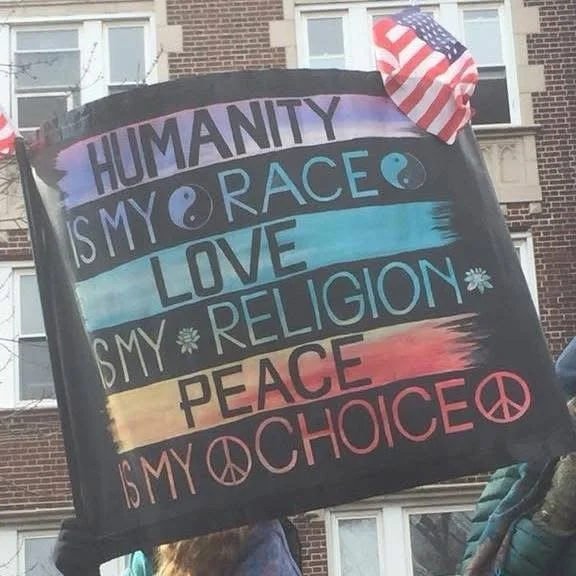
“Humanity is my race; Love is my religion; Peace is my choice” ... a sign my sister-in-law photographed at a rally she attended several years ago.
Who am I? I am someone who believes in the inherent value of all of creation ~ no exceptions. I am someone who believes that how I treat others impacts my own health and wellness. I am someone who is shaped by my faith and by the Gospels, and who models myself after Jesus who was both healer and revolutionary ~ Jesus who stands with those who live on the margins, but who looks with love even on those who might seem to be his adversaries. That’s the territory my heart and soul call home; it’s who I am, and as such it must shape how I connect with others.
I have a story of how being grounded in oneself can determine one’s actions. It’s an old family story, from my father’s youth, and one I heard him tell many times towards the end of his life. Dad was maybe 14 or 15, and like most mid-teenaged boys, was a bit reactive and hotheaded, by his telling of things. I don’t know the context (I think maybe baseball was involved? It usually was for him), but something prompted Dad to get really, really angry at his older brother, Harris, who was about 16 or 17 at the time. Dad popped off and punched Uncle Harris in the face … hard.
As Dad used to tell the story, Uncle Harris took a breath, smiled gently and maybe a bit sadly … and walked away. Of course, this made teenaged Dad even madder, but he never forgot that moment. I don’t really know what was going through Uncle Harris’s mind at the time, but I have to assume that his reaction was based on being deeply rooted in his understanding of himself. My guess is that there might have been a flash of instinct to hit back, but Uncle Harris was a pacifist, through and through, even as a teenager. In that split second between stimulus and response, I don’t think he even had to say to himself, “I probably shouldn’t punch Don, no matter how much I might want to.” My guess is that his narrative was more along the lines of, “I am not someone who uses violence. I am not someone who punches.” Uncle Harris knew who he was, and that level of self-knowledge mediated his behaviors in a way that changed the outcome of that afternoon.
The second strategy for maintaining connection and relationship in the face of differences is to be grounded in curiosity, in the desire to know one’s opponent. I am convinced that I can’t know someone without finding something lovable in them, and I want to love them, at least a little bit. So it’s not just “who am I?” It’s also “who are you?” If I am truly a person who believes in the inherent value of all of creation (no exceptions!), it is my responsibility to get to know my opponents, to understand their hearts and learn what makes them tick. My beloved colleague Susanna Griefen used to say that when we are faced with conflict, we must “turn to wonder.”
Who are you? I wonder … who do you love? What are the worries that keep you up at night? What hurts in your life right now? What are your fondest memories of childhood? What was your favorite movie when you were 16? I wonder … who are you?
Because of the violence of our times, I feel I need to write a caveat here: I am fully aware that the things I’m framing as “disagreements” are sometimes far more toxic, volatile, and dangerous than that simple word sounds. It’s not the job of those whose lives are endangered by oppressive ideas, actions, and laws to kindly get to know and love their oppressors. In instances like that, leaning into self-protection is wise and understandable. After all, if I feel unsafe, how comfortable will I be letting the “other” truly know me — and is that even my job? Resistance to regimes that spew hatred and division comes in many forms, and it may not be the role of every single human to focus on connecting and building community through a vulnerable combination of self-knowledge and curiosity.
Here’s what: none of this is easy. I wonder, though, what difference would it make if we all knew each other deeply, and tried to get to know our opponents, too? What difference would it make if we remembered that we belong to one another ~ no exceptions.
There’s a poem by the 13th-century Sufi poet that comes to mind for me as I think of the intractable-seeming nature of our massive cultural divides and how they harm us all:
Out beyond ideas of wrongdoing and rightdoing,
There is a field. I’ll meet you there.
(Translated from Persian by Coleman Barks and John Moyne, from The Essential Rumi, published by HarperCollins. Copyright © 1995 by Coleman Barks.)
That’s a field I long to lounge in. I’ll bring a picnic blanket. Maybe you’ll come, too.